As the millennial generation becomes increasingly diverse and liberally-minded, and the culture of binge-watching entertainment on streaming sites such as Netflix and Hulu becomes more commonplace, there is continuously a high demand for witty, funny, progressive content that is easily consumed and understood. Comedy Central has been able to deliver this type of content since the ‘90s with media texts such as The Daily Show and South Park – challenging or poking-fun at the status-quos of society, essentially uncensored. One of their newest shows, Broad City, is proving to be the most progressive project yet. The stoner drama is about two best friends in their mid-twenties, Abbi Abrams and Ilana Wexler, living in NYC and trying to find their paths post-college. They are not necessarily looking for love or romantic relationships, nor are they hell-bent on achieving professional careers, but they are living in the present, seeking to satisfy their social and sexual desires while remaining in-tune to current events and social constructs such as rape culture, sexism, and racism. In this essay, I use erotic analysis to argue that Broad City is a carnivalesque text that uses tropes of abjection and ambivalence. Through the evaluation of the episode “Co-Op” (season 3, episode 2), I will show how viewers interpret these tropes as means to access and satisfy pleasures.
According
to TV critic for The New Yorker Emily Nussbaum, Broad City started out in
2009 as a series of web video sketches. In 2014, the sketches became the “stoner
drama” the show is now, spearheaded by co-creators Abbi Jacobson and Ilana
Glazer (who also star as the show’s main characters, Abbi Abrams and Ilana
Wexler) and produced by Amy Poehler. Since then, there have been three full
seasons with ten episodes each and season four is to debut in summer 2017. From
the start of the show up until the episode that I am analyzing in this essay,
Ilana works (hardly) at an Internet start-up company called Deals Deals Deals.
Abbi works at a health and fitness club called Soulstice where she started out
as a “cleaner” but ultimately is promoted to be a trainer. Ilana is an
eccentric, pot-smoking, hyper-sexual being who views her sexuality and gender
on a spectrum and identifies as bisexual. She has romantic feelings for Abbi,
but Abbi is straight. Abbi is ultra-competitive, idolizes Oprah (she has a
tramp stamp to prove it), and can be a bit of a romantic as she is always
swooning over her neighbor and as Nussbaum puts it, anyone with a man-bun.
Broad City bodes itself well
to erotic analysis because it is so raw and progressive. It embraces the idea
of intersectional feminism in which women own their sexualities to the fullest
and aim to correct systemic oppressions beyond sexist issues. The episode
analyzed in this essay, “Co-Op,” encapsulates the show's themes regarding
sexuality and femininity as Abbi and Ilana switch places so that Ilana can keep
her membership to the local organic food co-op, but not miss her doctor’s
appointment in Long Island. While Abbi is acting as Ilana, she’s infatuated
with a hippie-white-guy named Craig who also works at the co-op, and Ilana
finds out on her way home from the doctor that Lincoln (her longtime
friend-with-benefits) had sex with another woman.
Erotic
analysis, according to Critical Media
Studies authors Brian L. Ott and Robert L. Mack, is concerned with audience
activity and how it is best understood through pleasure(s) (286). In defining
pleasure, Ott and Mack quote media critic Ien Ang:
“Both in common sense and in more theoretical ways of thinking, entertainment is usually associated with simple, uncomplicated pleasure –hence the phrase, for example, ‘mere entertainment’. This is to evade the obligation to investigate which mechanisms lie at the basis of that pleasure, how that pleasure is produced and how it works – as though pleasure were something natural and automatic. Nothing is less true, however. Any form of pleasure is constructed and functions in a specific social and historical context” (286).
In other words, there is a multitude of different types of pleasure, thus pleasure is complex and does not always serve dominant or hegemonic interests. Furthermore, media erotics says there are two kinds of texts that might elicit erotic pleasures: writerly and carnivalesque. A writerly text is “a text whose meaning is relatively unfinished and unsettled and, thus, invites the audience to co-create its meaning” (Ott & Mac 381). A carnivalesque text, on the other hand, “embraces and embodies the spirit of medieval carnival” (Ott & Mac 375). Ott and Mac write that the “carnival” was about (temporarily) celebrating liberation from the hierarchal forces of society (286). Gulnara Karimova writes in her article “Interpretive Methodology from Literary Criticism: Carnivalesque Analysis of Popular Culture: Jackass, South Park, and 'Everyday' Culture” that the carnivalesque is simply day-to-day life itself (37).
Under
the umbrella of carnivalesque texts there is the central idea of grotesque
realism, which is when a person or society values what is usually deemed as
lowly, material and devalues what is “high, spiritual, ideal, abstract” (292). Within
grotesque realism, Critical Media Studies
lists the grotesque body, abjection, uncrowning, and ambivalence as its
main tropes (292-293).
Grotesque realism is at work in
the central premise of Broad City because
Abbi and Ilana are always smoking marijuana, getting into trouble/pulling silly
stunts, and simply just trying to make ends meet. In the pilot episode of Broad City Abbi and Ilana are running
around all over NYC trying to make some money to attend a secret Lil Wayne
concert. In their ultimate failure to do so, Ilana tries to cash in office supplies
from her work and disappointingly only gets store credit in return, the girls
play buckets like drums in Central Park in hopes of collecting tips, and they even
clean a random man’s apartment in their underwear. Neither of the girls are destitute or homeless,
but neither of them live lavishly nor have a lot of money saved up. They value experiences and friendship above
social status and professional success. The
two also value their sex lives more than they do the idea of a committed
relationship.
Abjection
in Broad City
A
modern example of abjection would be videos that show huge cysts being drained
of puss or bloody surgeries – they are disgusting, but they get thousands and
millions of views because we cannot look away.
Ott and Mack describe abjection to be what fascinates and disgusts
(293). The Critical Media Studies authors
quote Julia Kristeva as defining abjection as “what disturbs identity, system,
order. What does not respect borders, positions, rules.” The abject is a trope
that is prevalent in comedy such as South
Park. In the article “South Park,
Blue Men, Anality, and Market Masculinity” by Judith Gardiner, she discusses
the anus and anything anal mentioned in
South Park as examples of abjection. One of the funniest episodes,
according to the male audience in which Gardiner writes about, is an early
episode in which the characters in South
Park are farting and laughing the entire time (259). Anal references in
comedy such as South Park are
sometimes silly and trivial, such as jokes about farting, but other times speak
to homosexuality and different religious views on homosexuality.
In
the “Co-Op episode of Broad City, there
are three primary instances as the anus being the abject. In the opening scene
of this episode, Abbi and Ilana are walking down the street discussing anuses. Ilana
tells Abbi confidently that she would most definitely be able to identify her
butthole in a line of buttholes. Ilana says that everyone’s is different – “each
one has a soul – an ass-soul.” Within the social construct of American society,
it is not socially normal to discusses anuses openly. This instance of the anus
as abject speaks to the comfortability Ilana has with her body and her
sexuality as well as the comfortability between Abbi and Ilana to literally be
able to talk about anything – no matter how taboo. This scene disturbs societal
order because typically, it is not lady-like for women to speak in such
explicit ways. There is also a bit of a shock factor by making this
conversation the first dialogue of the episode without any scaffolding whatsoever,
Ilana says “Oh, I guarantee I could identify my butthole in a lineup. One
hundred percent.”
In
this same scene, Abbi and Ilana’s conversation about anuses is interrupted by
some young boys playing basketball. Competitive Abbi challenges them to a game
of basketball, saying, “The only way you’re going to get to touch these boobs
is if they graze the top of your head as I’m slam-dunking your skinny ass!”
During the game, Abbi smacks Ilana’s butt in a congratulatory, sports-like
manner. In return, Ilana basically pokes Abbi’s butthole. Abbi shakes her head “no”
at Ilana in disproval. Ilana’s gesture is another example of the anus as abject
because even though the two are comfortable with each other, Ilana crosses Abbi’s
physical boundary by touching her in an unsolicited manner. This is not the
first time in the series that Ilana has crossed this boundary. This scene is
funny because anyone who watches Broad
City knows that it is sort of an ongoing joke in the series that Ilana is
sexually attracted to Abbi even though Abbi is straight. Even though Ilana’s inappropriate
touching is abjection bringing light to the importance of respecting physical
boundaries, the conversation about anuses hysterically helps to promote
sex-positivity among women and comfortability with one’s body and sexuality.
The
third example of the anus as abject happens just before Ilana asks Abbi to work
as her in the co-op that day in order
to keep her membership. Ilana has been cooking for Abbi with the food they get
from the co-op, and Abbi says that all of the healthy produce has been giving
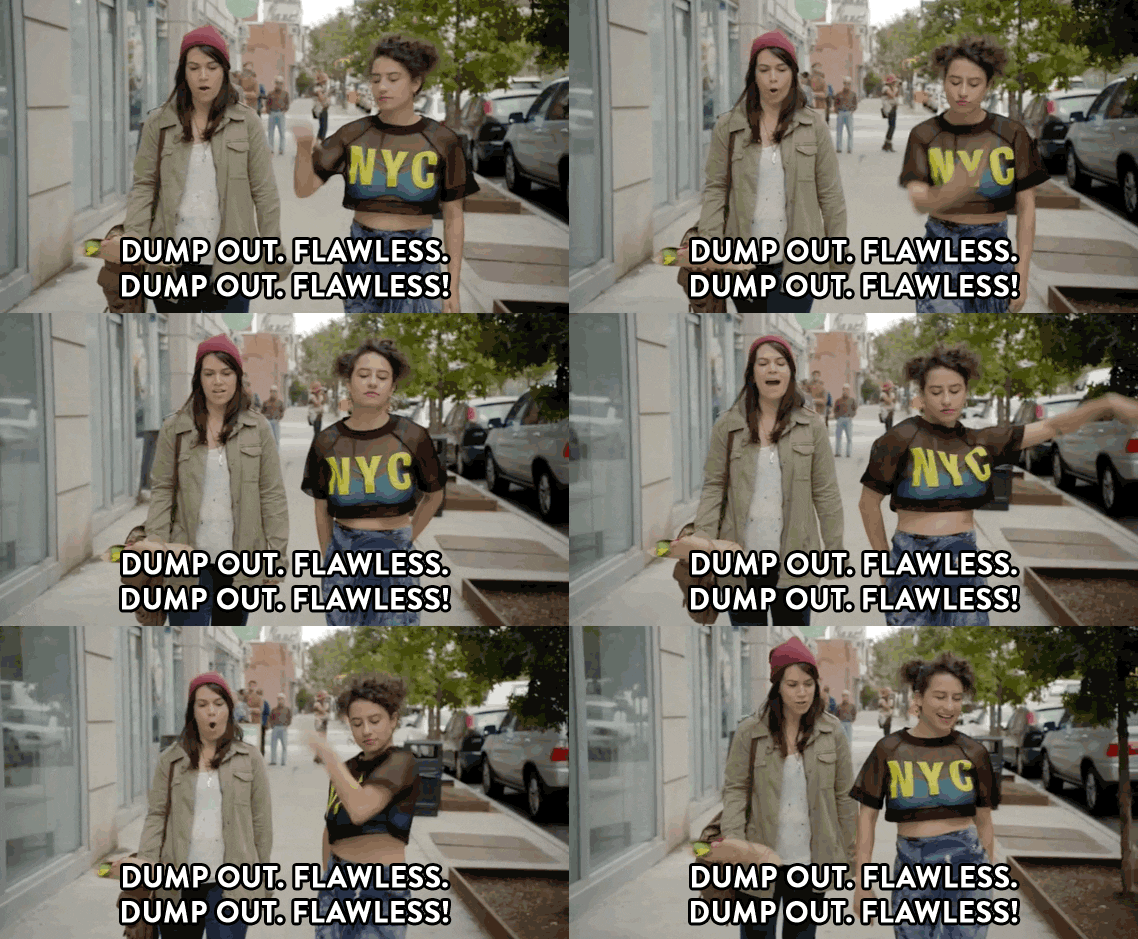
her “the healthiest shits” of her life. Abbi then sings a little rendition of
Beyonce’s “Flawless” and says about her bathroom experiences: “Dump out – flawless.
Dump out – flawless.” In this instance, Abbi is talking about defecating, something
that is primarily viewed as disgusting, hilariously, casually, and positively.
Ott and Mac write in Critical Media
Studies “that which is discharged or expelled from the body (i.e. menstrual
blood, spittle, sweat, urine, feces, mucus) evokes disgust and revolt” (293).
This scene is comedic because Abbi is juxtaposing Beyoncé – a pop culture,
feminist icon to the two women as well as the millennial viewing audience – and
“dump(ing).” This very juxtaposition is
a prime example of how carnivalesque texts elevate was is lowly (defecating)
and downplay what is high-culture (Beyoncé).
Ambivalence
in Broad City
Ott
and Mac write that within carnivalesque texts, new ways of thinking and
existing in the world are generated because of conversations dealing with the nuances
between “contradictory feelings and impulses like fear and elation, seriousness
and humor, praise and abuse…and certainty and uncertainty” (293-4). Ambivalence
is essentially how social change is created or promoted through comedy. Paul
Martin’s article “’The Man for His Time’ The Big Lebowski as Carnivalesque
Social Critique,” analyzes how the film The
Big Lebowski challenges hegemonic social hierarchies and social order in
general (300). Martin writes that
comedic texts should never be overlooked or dismissed as trivial because they
have the capabilities to communicate grotesque imagery and hierarchal inversion
(310). Broad City, like The Big Lebowski, challenges hegemony and
social norms in extremely progressive ways, particularly in regards to sexuality
and correcting rape culture.
Ilana’s
sexuality and relationship with Lincoln are ambivalent in “Co-Op” because even
though she claims to be knowledgeable about rape culture – its language and its
implications – she often (ironically) perpetuates it herself through her actions
with Lincoln and her overall openness to speak and act sexually. When Lincoln
is driving her to the doctor, she gets in his lap and says that she needs to be
swaddled. When Lincoln tells her to get off, it’s not safe for her to be
sitting on his lap while he’s trying to drive, she suggests they switch places
so he can give her “road head.” Since this is an act that typically implies the
man to be driving and receiving oral sex, Lincoln asks how that’s even
possible. Ilana says “OK, road hand. Whatever. Just quit the pillow talk and
get me off.” From a feminist analysis, this is an example of role-reversal. It
is funny that Ilana is acting in such a way, but when men are demanding and
forceful in seeking sexual pleasures, we call it rape culture. The viewer sees
how out-of-the-ordinary this interaction between Lincoln and Ilana is and thus
the interaction is ambivalent because of how the binary of male as dominant,
female as submissive, is disrupted/flipped.
 |
| Abbi, channeling her inner Ilana at the co-op. |
Abbi’s
impersonation of Ilana while working at the co-op is another example of
ambivalence at work in this episode. Ilana is always hyper-sexual, which the
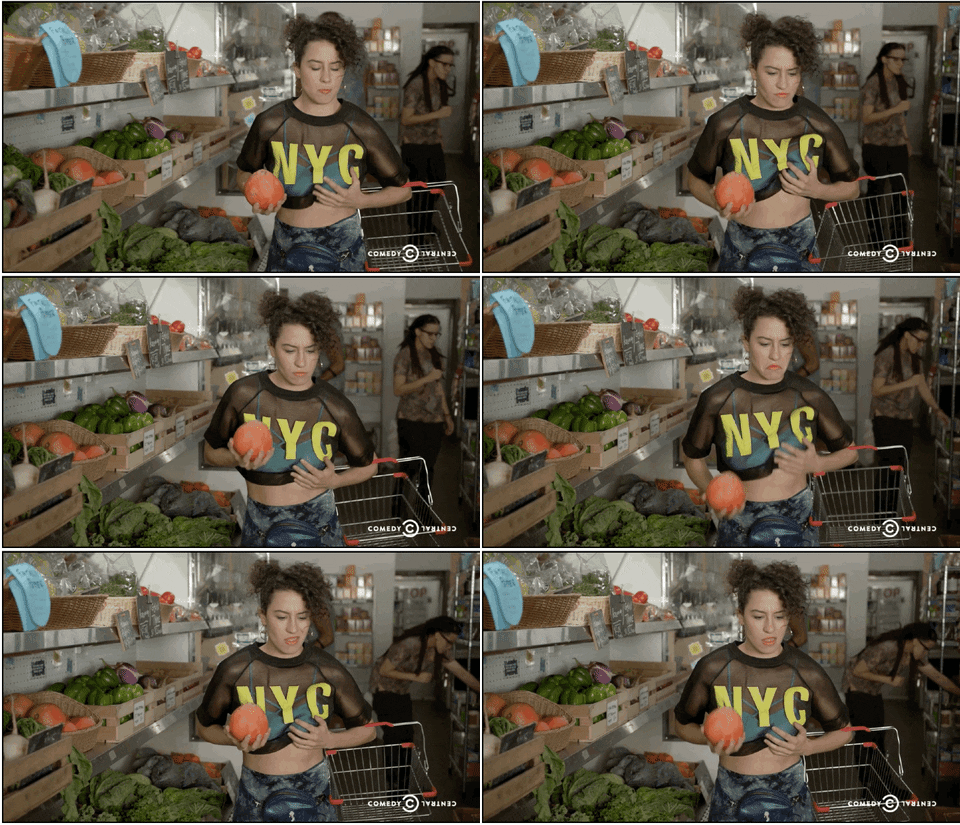
viewer sees in the beginning of the episode when she is shopping for fruits and
vegetables and fondles, caresses, and licks a tomato, a cucumber, and an
orange, as if they were sexual body parts. However, when Abbi is acting as
Ilana in the co-op, she is so sexual that it becomes rude in a few different
instances. Abbi (pretending to be Ilana), blasts into the co-op announcing
herself and that “rape culture sucks!” after that, she touches her breasts and
simply just acts ridiculously while everyone is looking at her. Later on, she
addresses a manager at the co-op by her wrong name, twice, and pretends to masturbate
an eggplant in the manager’s direction, making her extremely uncomfortable.
Craig, the co-op worker Abbi has a crush on, even tells her to “respect the
produce.” This is an example of ambivalence because it shows that while owning
your sexuality is a positive, healthy practice, there is a time and place for
everything. Ilana is supposed to be a
champion for equality and sexual liberation, however, her efforts fail when her
actions are disrespectful to others. Abbi’s over-dramatic acting efforts to be
Ilana heighten this ambivalence, but, it is still true that Ilana’s sexual
expressions often run contrary to what she truly believes.
Ilana’s
personality – her bisexuality and her loudness – makes her grotesque and
contributes to her carnivalesque character and its ambivalent effect in the
show. In the article “The ‘Grotesque’ Pussy: ‘Transformational Shame’ in
Margaret Cho’s Stand-up Performances,” author Susan Pelle writes about how
Margaret Cho’s stand-up comedy is ambivalent in that it promotes an
intersectional approach to sexuality and gender by her being so explicit and
over-the-top (21). Ilana is a lot like Cho in this way. Even though oftentimes Ilana’s
actions and words are often problematic in attacking hegemony, they still always point out hegemony
and spark discussion. The reaction a viewer of Broad City might have to Ilana’s craziness could be: I can’t believe she did! Or I can’t believe she said that! But that
shock and initial shaking-of-the-head often turns into reflection and change.
Some of the ways that Ilana acts are unacceptable. So, why is it acceptable
when men act in those ways?
A
final scene that depicts ambivalence in “Co-Op” is when Lincoln tells Ilana he
hooked up with another woman. Even though Ilana does not want a committed
relationship with Lincoln, and sleeps with other people herself, her initial
reaction to this news is a dramatized (hilarious) version of how a woman might
react if her partner told her he/she was cheating on her, according to social
norms of women being more sensitive and loyal than men. Ilana angrily gets out
of the car, yells, rips plants out of the ground, attempts to climb a tree,
then jumps up and down on the hood of Lincoln’s car. Once she is done having
this fit, she has a complete 360 perspective on the situation and thanks
Lincoln for telling her about it. She then talks about how they are “open sex
friends” and also a “modern-day Will and Jada.” Ilana then tells Lincoln, “Maybe
we can trick her into having a threesome with us.” Lincoln responds right away
that no one should ever trick anyone into having sex with them. Ilana agrees,
realizes that she already knew this, she just had to hear it from him (a man)
for it to hit home. She then has to leave, and gives Lincoln a “penis kiss” on
her way out. This is another example of Ilana’s problematic language/actions becoming
ambivalent to addressing rape culture and patriarchy in an ironic, comedic way.


When
Ilana switches from raging out of anger about Lincoln’s news about hooking up
with someone else to her much happier self, being excited about their newfound “openness”
to their relationship, she says that they are bi. Lincoln says he is not,
almost defensively, then quickly adds to his statement, “Yeah… I know… How do I
really know if I never have tested my boundaries?” By making this statement,
Lincoln is being supportive of Ilana’s beliefs in sexuality being a spectrum
and not a strict binary. Then, at the end of the episode, Ilana is talking to
Abbi about how happy she is that Lincoln slept with someone else. She even
recites the details of their sexual encounter, telling Abbi how Lincoln was a
sweetheart for giving the woman water to take her cranberry pills because she
is prone to UTIs. Abbi is a bit shocked that Ilana is so happy and excited
about Lincoln, and asks her if she’s sure she’s not jealous. Ilana says, “You
know, if you love something, you have to let it have sex with other people. And
if it comes back to you… Dope. Because then you also get to have sex with other
people.” Ilana’s comfortability with
polygamy and is in direct opposition of the hegemony of traditional relationships
in which the ultimate end goal is marriage. Ilana’s attitudes are ambivalent in
that they promote a sex positive culture in which sexual partners are open and
honest with one another. By being happy for Lincoln and appreciative of his
honesty, she is asserting her own sexual independence.
Typically, in most media texts,
bisexuality is never this explicit or accepted. In the article “Bisexuality in the
Media: A Digital Roundtable,” media scholar Amy Andre criticized popular media
for remaining implicit about bisexuality, discussing Friends and Seinfeld respectively:
“Overall, I think that these TV shows represent bisexuality and bi-eroticism as
implications in people’s lives, and without exposition… Rare is the character
who utters the words, ‘I’m bisexual,’ however regularly the plotlines include
characters who have attractions and interactions with partners of more than one
gender” (Alexander). Ilana’s sexuality in Broad
City is extremely explicit. Since monogamy among cis-gendered, straight
people is often the default narrative of sexual relationships, Ilana and
Lincoln’s support of Ilana’s beliefs, makes Broad
City a progressive, ambivalent show that challenges traditional hegemony in
society.
Through the tropes of abjection and ambivalence within the carnivalesque theory of text, it is evident that fans of Broad City are interpreting these messages that challenge society's status quos, whether that be about relationships, sexuality, rape culture, and simply how a woman should speak and behave.
Creative Component
A way in which Broad City could be a lot better for being truly progressive and initiating social change would be to allow Ilana's character to be more reflexive about her words and actions regarding her sexuality. Yes, sometimes Lincoln or Abbi will correct her by telling her "hey, you shouldn't trick anyone into having sex" or to not touch someone who does not want to be touched, but not all of her behavior is acknowledged as problematic.
Through the tropes of abjection and ambivalence within the carnivalesque theory of text, it is evident that fans of Broad City are interpreting these messages that challenge society's status quos, whether that be about relationships, sexuality, rape culture, and simply how a woman should speak and behave.
Creative Component
A way in which Broad City could be a lot better for being truly progressive and initiating social change would be to allow Ilana's character to be more reflexive about her words and actions regarding her sexuality. Yes, sometimes Lincoln or Abbi will correct her by telling her "hey, you shouldn't trick anyone into having sex" or to not touch someone who does not want to be touched, but not all of her behavior is acknowledged as problematic.